
”Each nation has a unique tone to sound in the symphony of human culture; each nation is an indispensable and irreplaceable player in the orchestra of humanity” – I.L. Claude. ”National Minorities : An International Problem”
2013 witnessed a particularly brutal wave of attacks on the houses, temples and businesses of panicked and devastated Hindu communities, on a district wide assault, ancient places of worship spanning centuries have been vandalised. From the various investigations ASK have conducted, the attacks have been found to be systematically conducted in order to terrorise the people and their communities. Instead of stealing goods, personal belongings such as, motorcycles, computers, televisions, household items have been smashed. Windows, walls, fencing, vandalised. The attacks were triggered by the verdict of the International Crimes Tribunal sentencing Delwar Hossain Sayeedi, the Vice President of the Jamaat-e-Islami to death for the crimes commited during the 1971 Liberation War on 28 February 2013. There was one round of attacks in the spring (see table below), the second round started pre elections during hartals and blockades called by the opposition party when the government decided to continue the elections without the opposition.
ASK considers that these incidents of communal attacks are a serious threat to democracy, peace, religious tolerance and harmony.
The failure of the administration to bring the situation under control was obvious. We consider that these inhuman, undemocratic as well as criminal acts should come to an end.
We urge the government to take immediate action to stop the recurrence of such incidents and take legal action against the perpetrators.
Violence in 2013
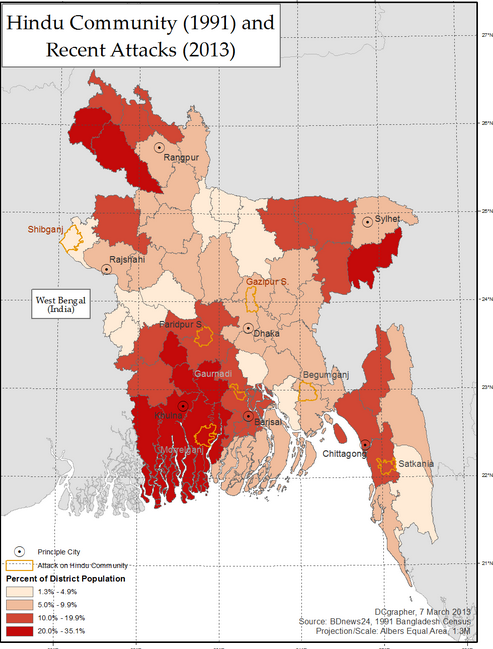
Attacks from 28 February reported by BDnews24 (there are 1, 2, 3, 4, 5 reports mentioning 7 distinct sub-districts) Click Links to View
- Comprehensive Summary of Attacks in Spring 2013
- Urgent Appeal Sent by ASK Regarding Attack in Lalmonirhat on 27 November 2013
- Attacks on Religious Minorities Continued on this Scale into 2014 , immediately after the General Elections.
Writ Petition Filed
Ain O Salish Kendra (ASK), BLAST, Samprodayikota O Jongibad Birodhi Moncho (Platform against fundamentalism and terrorism), Hindu Budhdho Christian Oikko Porishad (Coalition of Hindu Boddho Christian), Bangladesh Puja Udjapon Porishad (Puja celebration committee), ALRD and Ziauddin Tarique jointly filed a writ petition in the Divisional Bench of High Court Division comprised of Justice Naima Haider and Justice Zafar Ahmed. The writ petitioners submitted numerous newspaper reports on the attack and torture on minorities. Statistics prepared by Documentation Unit of ASK based on the reports in different newspapers shows that:
- 94 incidents of violence have been reported.
- In these incidents 187 homesteads and 162 business enterprises owned by the minorities have been attacked, looted and set on fire,
- 89 temples and 113 Idols have been vandalized and burnt down.
- Only 33 cases have been filed among 90 incidents of violence, according to the statistics.
Fact finding reports from ASK were also submitted to the court. Petitioners argued that the government has failed to ensure security of the minorities. Failure of the Government has violated the Constitutional right to protection of law under Article 31 and right to life under Article 32 of the minorities. In this situation intervention of the apex court is urgently needed to provide adequate security and ensure their rights under the Constitution. After the hearing, the Divisional Bench issued a rule nisi asking the Government to show cause as to why the inaction of the Government should not be declared illegal. It asked the Government to form a high power committee to probe into the matter. Besides, it directed the Government to identify the risk prone areas and provide adequate security to the minorities of those areas. High Court also directed the government to file a report within 3 weeks on which measures have been taken to ensure security of the minorities. The Government did not respond to the direction.
State Responsiblity
Legal provisions on Religious in the Constitution of the Peoples Republic of Bangladesh.
The principle of secularism shall be realised by the elimination of (a) communalism in all its forms ; (b) the granting by the State of political status in favour of any religion ; (c) the abuse of religion for political purposes ; (d) any discrimination against, or persecution of, persons practicing a particular religion.
Fundamental Rights Equality Before the Law
Article 27 All Citizens are equal before the law and are entitled to the equal protection of the law. Discrimination on grounds of Religion.
Article 28 The State shall not discriminate against any citizen on grounds only of religion, race, caste, sex or place of birth.
Article 41 (1) Subject to law, public order and morality (a) every citizen has the right to profess, practise or propagate any religion; (b) every religious community or denomination has the right to establish, maintain and manage its religious institutions.
(2) No person attending any educational institution shall be required to receive religious instruction, or to take part in or to attend any religious ceremony or worship, if that instruction, ceremony or worship relates to a religion other than his own.
International Mechanism
Thematic Issue: Minorities and Indigenous Rights & Discrimination Against Vulnerable Groups
- Consider the possibility of enacting laws for the protection of the most vulnerable groups from social discrimination (Ecuador)
- Ensure the effective investigation and sanctioning of all cases of violence against religious minorities (Austria)
- Address all acts of religious intolerance and discrimination (Slovakia)
- Take measures to ensure that Constitutional and legal protections for religious minorities are upheld and in particular that their places of worship are protected, including from violent attack (Canada)
- Employ further measures to ensure the security of religious minorities, including Buddhists and Hindus (Japan)
- Promote more intercultural education and ensure that marginalized groups enjoy equal rights before the law (Thailand)
- Continue to guarantee the rights of religious and ethnic minorities (Djibouti)
- Continue working to provide State care to vulnerable and minority groups in the country, to ensure they are fully integrated into society (Nicaragua)
Government Response
- The Foreign Minister also reiterated her Government’s commitment to build a secular society and not to countenance any threat and attacks against the country’s religious minorities such as the attacks on Buddhists in Ramu last year or the recent attacks against the Hindu community.
- The foreign minister highlighted the Constitutional recognition given to the country’s ethnic groups and tribal communities through the 15th Amendment and the measures taken to implement some of the critical issues under the CHT Accord.
- The Foreign Minister elaborated on the concrete measures taken by her Government to protect the rights of the vulnerable and marginalized groups in society, including persons with disabilities and refugees, among others.
- The Minister said Bangladesh would remain committed to upholding family values and tradition as well as human rights of all individuals. The Minister informed that an Anti-Discrimination Law is in the offing to protect the rights of socially marginalized groups, who are also covered under Social Safety Net Programmes. The Small Ethnic Groups Cultural Institutions Act, 2010 has been enacted to preserve and promote the cultural identity of the ethnic minorities.



 Visit Today : 620
 Visit Yesterday : 2164
 Total Visit : 427640
 Who's Online : 18