
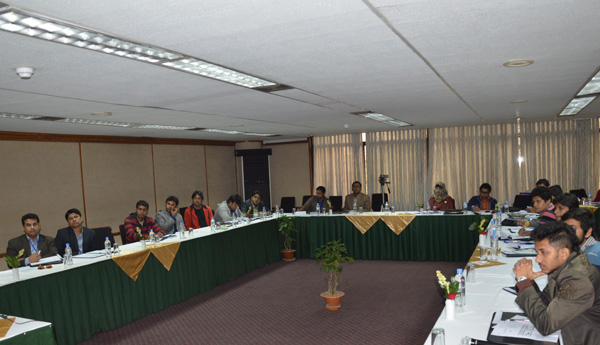
 Media is recognised as one of the vibrant sectors of society, in the context of Bangladesh. In a democracy, media is considered as the “Fourth Estate”. Over the time it has become quite evident that, the role of media in promotion as well as protection of human rights is very critical.Sultana Kamal, Executive Director of Ain o Salish Kendra (ASK), expressed these opinion while inaugurating the dialogue between human rights defenders and journalists, titled, “Dialogue with Journalists as Human Rights Defenders: Working Together for Promotion and Protection of Human Rights” held on 23-24 December 2014 at Brac Inn. 25 participants from different media houses (print, electronic and online) attended the dialogue and shared their experiences.
This dialogue was aimed to build cooperation and support between human rights defenders and media fraternity in enhancing the spirit of working together through knowledge and experience sharing. Ain o Salish Kendra organised the dialogue to provide reliable information to journalists working on human rights issues and equip them with necessary skills for dealing with complicated issues.
Themes like ‘Understanding Human Rights- its evolution and core principles, Role of Media in Human Rights Activism, Policies on Media and the Independence of Media and risks and Challenges faced by journalists’ are discussed on this dialogue. At the end of two days dialogue, both journalists and human rights defenders explored the ways to work together and strengthen their joint efforts as human rights defenders.
Journalists as Human Rights Defenders
- Discussants of the dialogue expressed that rights defenders address human rights concerns and work for its promotion and protection using all possible ways under national and global HR mechanism.
- The Journalists who report on human rights violations are also human rights defenders and playing a salutary role in creation of larger awareness on human rights. They also highlight the method of protecting human rights of people.
- Journalists are performing this role in different ways.They make people aware of their rights, expose incidents of human rights violations and focus on protection of human rights and pursue relevant cases in this regard.
- Thus, they build a medium of communication between the state and citizens and play an effective role to make concerned authorities accountable by creating awareness aboutduties and putting pressure to take immediate actions against violators.
Journalist and Columnist Faruk Wasif expressed that, journalists are under an “administration of fear” and this fear derives from different sources – State authority, powerful groups against whom they report and sometimes from their workplaces. Working for the truth and rule of law is the only way to overcome this culture of fear and Human Rights Defenders as well as journalists need to work together to conquer this fear.
Sultana Kamal opined that, State has the foremost responsibility to protect human rights of its citizens. But we have noticed that sometimes ignoring that responsibility, state is using monopoly of violence to curtail human rights of its own citizens. It carries out state sponsored violence- extra-judicial killings, enforced disappearance, torture through law enforcing agencies and enacted repressive laws which contradict with core principles of human rights. Human Rights Defenders and journalists can act together to prevent this monopolistic behavior of State and also to ensure its accountability.
One participant at the dialogue mentioned that Limon could be a good example where media and Human Rights Defenders have been working together continuously from the very beginning to defend his rights. They have mobilized public opinion and created pressure on the relevant authorities. And finally Limon has received some positive responses.
Risks and Challenges faced by the journalists
 Khaled Muhiuddin, Chief News Editor of Independent Television, expressed that media houses are run by powerful quarters of the society and thus most of the time they speak for them ,not for general citizens of the society.
Professor of University of Dhaka, Rubaet Ferdous shared his experiences as a Human Rights activist as well as a columnist. He stated that sometimes media don’t publish any column because of their policy or being pressurised by certain sections of the State. He also added that three things are required for activism and journalism, that is – honesty, fairness and objectivity. These three things will protect journalists or activists from pressures or risks which will certainly come across.
Renowned lawyer, Sara Hossain mentioned ‘freedom of expression is the fundamental to all kind of human rights. When Hitler came to the power, the first attack was made against freedom of expression of German people which ultimately lead to the Second World War.
Journalists from online media and bloggers raised their concerns about the “Information and Communication Technology Act (amendment), 2013” and its vagueness, specially Section 57 of the law. According to them, selective application of this section has become a major concern to exercise freedom of opinion and expression.
Director (Bangladesh and South Asia) of Article 19, Tahmina Rahman stated that freedom of expression has been threatened by both state and non-state actors (extremist groups, corporate houses, business houses etc). But no action has been taken by State against these non-state actors. An unholy alliance exists somewhere in between state and non-state actors. Journalists have also become reluctant to take legal steps when they face any challenge or attack. Most of the times, they don’t get proper support from laws, relevant state institutions and above all from their media houses.
Participants shared their experiences and expressed concerns related to their professional and physical safety which they have experienced while working. The idea came up from the discussion that unity among journalists and strong associations for protecting their rights can be an effective platform to overcome these challenges.
Working Together: Protection of Human Rights Defenders
 Executive Director, Transparency International Bangladesh (TIB), Dr. Iftekharuzzaman presented the global instruments (UN, regional and international) which can be availed for the protection of journalists and to reinstate freedom of expression. Tahmina Rahman also added that the role of international organizations should not be limited only in issuing press statements. Considering the multi-faced threats, they should find out a comprehensive strategy focusing what else can be done to enhance moral pressure on the states. Full time member, National Human Rights Commission (NHRC), Kazi Reazul Haque, opined that the Government should enact a law or take a policy to protect the journalists. He also expressed that NHRC will advocate with the government for a direction, policy or law for the journalists.
After two day discussions, participants agreed that the dialogue has been a successful attempt to initiate a bridge between journalists and human rights activists’ as human rights defenders. Joint efforts from both sides will boost human rights activism in the country.


 Visit Today : 1059
 Visit Yesterday : 2334
 Total Visit : 430413
 Who's Online : 11