

From Left to Right : UN Special Mandate Holders | Milena Pires, Heisoo Shin, Kamala Chandrakirana. Khushi Kabir – Nijera Kori, Convened the session
The national consultation with the special United Nations Mandate Holders on “Framing Development Justice” for women in the Readymade Garments (RMG) sector of Bangladesh was held at the BRAC Centre Inn Auditorium on October 30th, 2013. The consultation was organised by the Asia Pacific Forum on Women, Law and Development (APWLD), Ain o Salish Kendra (ASK) and Nijera Kori. The consultation brought together various stakeholders of the sector, including workers, union leaders, activists and authorities, to hear the experiences of women suffering from occupational hazards in the RMG industry and identify the challenges that need attention and action. It enabled the voices from the ground to reach the UN special mandate holders. They advised to the activists to submit official communication to the relevant special procedures addressing the realities.
Khushi Kabir, Coordinator of Nijera Kori moderated the discussions.
Who Were the Mandate Holders?

Heisoo Shin | ”What are the new policies for checking old buildings? These recent tragedies mean the government needs to upgrade policies”
Heisoo Shin is an Expert Member of the Committee on the Economic, Social and Cultural Rights, which is constituted with 18 independent experts to monitor the implementation of the International Covenant of Economic, Social and Cultural Rights by States parties.
Kamala Chandrakirana is a Member of working group on the Discrimination against women in law and in practice.
Milena Pires is an Expert Member of the Committee on the Elimination of Discrimination against Women (CEDAW). The Committee monitors the implementation of the convention on the Elimination of the All Forms of Violence Against Women.
Living Wage for the Workers
Kate Lappin- Regional Coordinator of APWLD in her presentation explained that, the living wage,calculated based on a combination of food and non-food costs, is the minimum income required to meet the basic costs of living for a family of two adults and two children, without requiring overtime work. She showed that the calculated living wage for Bangladesh is Tk. 13,254.
Fahmida Khatun- Director, Centre for Policy Dialogue Bangladesh mentioned that Garment workers receive the lowest minimum wage among all major industrial sectors in Bangladesh, and there is constant pressure from buyers and manufacturers to keep wages down in order to ensure their own profits. Making matters worse are the subcontracting factories that compete with manufacturers for low cost, resulting in a race to the bottom that further contributes to the injustice.
Victims and Activists shared their experiences
Several victims from Rana Plaza and Tazreen Factories had the opportunity to share their experiences. Activists who had been working with the garment factory victims spoke about the struggles with DNA Testing process, victim and rescuer support, compensation, health care etc.
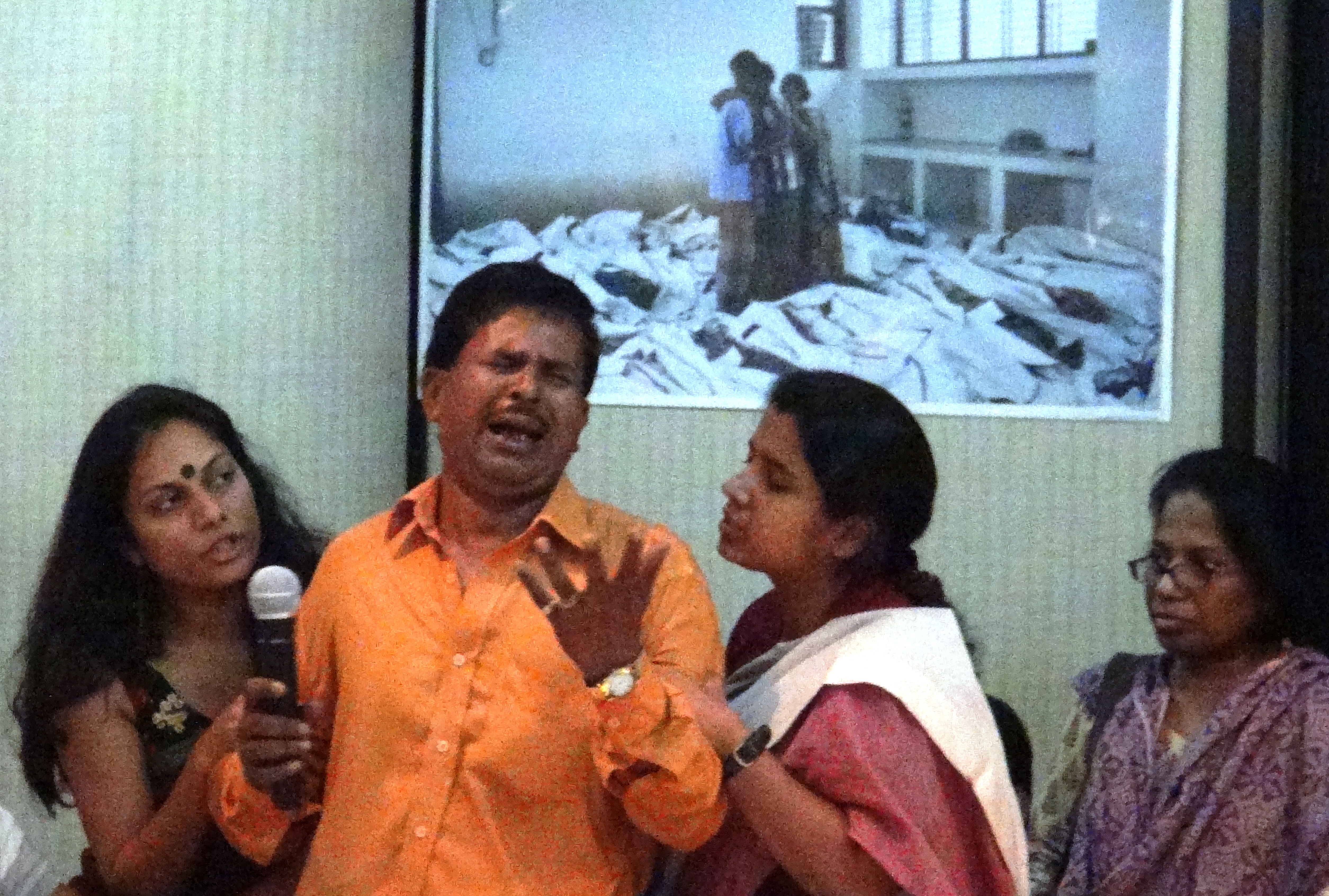
Father of three victims of Rana Plaza being held back by campaigners for the justice of Garment workers, (left) Taslima Akhter and Saydia Gulrukh. In the background, a photo taken by Taslima Akhter of a family mourning in a room of Rana Plaza Corpses.

Ale Noor-,Victim of Tazreen Garments fire. Ale Noor is one of many such survivors who continue to struggle with disabilities and economic hardship in the aftermath of the tragedy, calling to attention the necessity of continued rehabilitation support for victims.
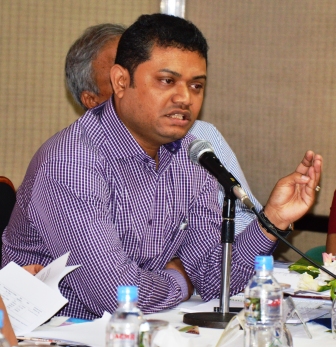
”a specific criminal case needs to be filed against the owner, we need to set a precedent that factory-owners cannot go unpunished. That, they are not above the law.”
The Barrister who feels strongly about non enforcement of existing laws in the garments industry context, Jyotirmoy Barua, spoke about the writ petition he filed against the Owner of Tazreen Fashions for criminal negligence. The writ was filed by three anthropologists, Naznin Akter Banu, Saydia Gulrukh Kamal and Mahmudul Hasan Sumon, seeking directives for the arrest of Tazreen’s owner Md Delwar Hossain to ensure his trial for criminal liabilities.
Barrister Jyotirmoy shared that, though a majority of the accidents in garment factories can be traced back to the deliberate negligence of factory owners, bribing, nepotism, case file disappearances, etc. have impeded arrest and proper trial of those guilty. In the case of the Tazreen Garments fire, owner Delwar Hossain is yet to face trial even after a Probe Committee report was submitted by the government acknowledging the deliberate negligence of the owner in ensuring safety standards, which made him eligible to be tried under criminal law.
He also informed that, in the most recent hearing for the writ petition, the High Court has ordered the government pay for the treatment of Sumaiya Khatun, a Tazreen factory worker who has developed cancer since her ordeal trapped inhaling fumes in the Tazreen fire. The government has yet to respond whilst her condition has been deteriorating rapidly while undergoing chemotherapy, she has lost her sight and hearing.
He concluded saying that until support from state and the legal system can be established, activists and human rights lawyers will continue to struggle to find justice, and crimes committed against garments workers will continue to go unpunished.

“Events like Tazreen and Rana Plaza are reported as an ‘unfortunate event that happened.’ But when a similar event happens over and over, it’s not an accident. It’s structural killing.”
Saydia Gulrukh, one of the panelists at the consultation, said that instead of euphemising these incidents as “tragedies”, we should recognize them as acts of deliberate negligence and bring the relevant authorities to justice. Rescue and rehabilitation processes need to take into account the realities of the situation and limitations. Given the state of forensic science in Bangladesh, reliance on DNA tests is not an adequate or efficient way to determine compensation. Nor are one-time compensations sufficient to cover the cost of medical expenses of survivors with long-term health consequences.
She also emphasised the importance of the Bangladesh government ratifying the ILO Convention C121 (click to view), concerning ”Benefits in the Case of Employment Injury” (Entry into force: 28 Jul 1967). She has been witnessing the problems which the victims and their families have had to face since the Tazreen Factory Fire, through to SMART fashions, Rana Plaza and the recent Aswad Composite Garments factory accidents.
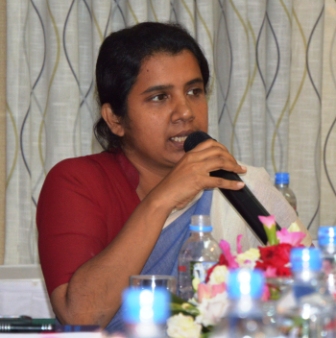
”Why are our Bangladesh workers viewed as the cheapest therefore disposable labour?”
Taslima Akhter, a photojournalist and an active campaigner for workers rights from the Bangladesh Garment workers Solidarity, highlighted how the workers were not to blame if there was a dent in the garment industry of Bangladesh, it is the owners, building inspectors, BGMEA and the government who are to blame for not taking the necessary measures to meet their needs and empower them with the rights they are entitled to. She spoke of the garment workers in Bangladesh being perceived as the ”cheapest” therefore disposable, hence the lack of value for their rights.
She also pointed out that we also need to be wary of the fact that trade unions are not the panacea to ensuring workers’ rights as union leaders are often controlled and bought off by factory owners, making it increasingly more difficult for workers to protest against violations without putting their jobs at risk.
Commenting on the testimonials of the garment workers, Khushi Kabir pointed out that the responsibility to act and address the highlighted concerns lies at all levels- with international bodies, governments, trade unions, owners, and citizens. Scarce employment opportunities have driven many women to work in this sector, but there is need to strengthen their bargaining power through trade unions. Workers should be granted the rights they deserve, but this does not need to come at the expense of threatening the industry.

BGMEA Representative listened as the Union Representative spoke of the shameful figure submitted by the BGMEA for Minimum wage of garment workers

Government representative from the Ministry of Labour, Aminul Islam admitted there were many errors made in dealing with a disaster of this scale

Kamala Chandrakirana, ”Complaints should be launched to the Working Group by international bodies and grassroots organizations providing further information on these incidents so it can write to the government with recommendations on how to increase the effectiveness of its remedial efforts and prevent similar disasters from arising in the future.”
Recommendations from the Consultation
- Government should follow international human rights standards since it is party to several international treaties protecting the rights of workers
- Complaints should be launched to the Working Group by international bodies and grassroots organizations providing further information on these incidents so it can write to the government with recommendations on how to increase the effectiveness of its remedial efforts and prevent similar disasters from arising in the future.
- Investment is needed from manufacturers, buyers and development partners to improve skill and efficiency of workers and to modernize factories with improved technology and working conditions, all of which will contribute towards increasing productivity.
- These investments need to be carefully monitored to ensure accountability and transparency. In addition, subcontracting firms should be integrated into the supply chain in order to remedy the compliance and capacity issues of these factories.
- The wage should be calculated on the basis of the take-home pay earned during normal working hours, without counting overtime that diminishes the workers’ health and well-being.
- Existence of trade unions is vital. Trade unions are a must if we want to guarantee the rights and security of workers and give them bargaining power. Fighting for workers’ rights for decent wage and working conditions would allow employers the chance to benefit from the increased buying power of workers, which in turn will increase the buying power of the entire economy

Milena Pires , ”The Committee on CEDAW evaluates compliance of states with the CEDAW Convention. Though Bangladesh has ratified both the Convention and the Optional Protocol of CEDAW, it made reservations on two articles of the Protocol that repeals the right of the Committee to initiate inquiries on grave and systemic violations of women’s rights within the jurisdiction of the country. Had the authority been granted, the discrimination against women garment workers in Bangladesh, especially in light of the recent Rana Plaza collapse, would have provided sufficient grounds for the Committee to initiate an investigation”
- The discrimination experienced by young women employed in this sector needs to be incorporated into the compensation system
- Short-term priorities should include- a) publication of the probe committee report and DNA report in order to regain public trust and identify the accountable parties for the systemic violations, b) addressing the stigmatization of the men and women fighting for the rights of the victims as foreign agents, and c) necessity of discussing the UN Guiding Principles on Business and Human Rights with BGMEA representatives.
- The civil society and the legal sector need to work together to create pressure on the authorities and the government to ensure workers’ rights. Responses should focus on improving working conditions rather than shifting the industry that plays such a vital role in the economic growth of Bangladesh.
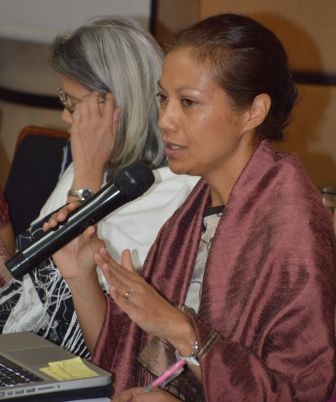
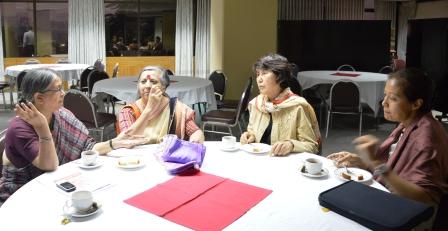
Sultana Kamal- Executive Director, Ain O Sailish Kendra (ASK), in her concluding remarks , said that, “a mutual sense of responsibility and accountability need to exist between workers and manufacturers to contribute positively towards the development of the RMG sector. The concerned authorities need to be wary and respectful of their duties as these recurring factory accidents are not isolated incidents, but direct results of continuous negligence and irresponsibility on their parts. The state needs to create pressure on the factory owners, who enjoy government facilities and access to public funds, to offer a living wage to their workers and thereby guarantee the right to healthy living to its constituents. Similarly, garment owners also need to be held responsible and accountable to citizens for the injustice and violations of workers’ rights. Unless everyone plays their part in putting an end to this injustice, lives will continue to be lost, and the prospects of the whole sector would be compromised.”



 Visit Today : 721
 Visit Yesterday : 2288
 Total Visit : 425577
 Who's Online : 10