
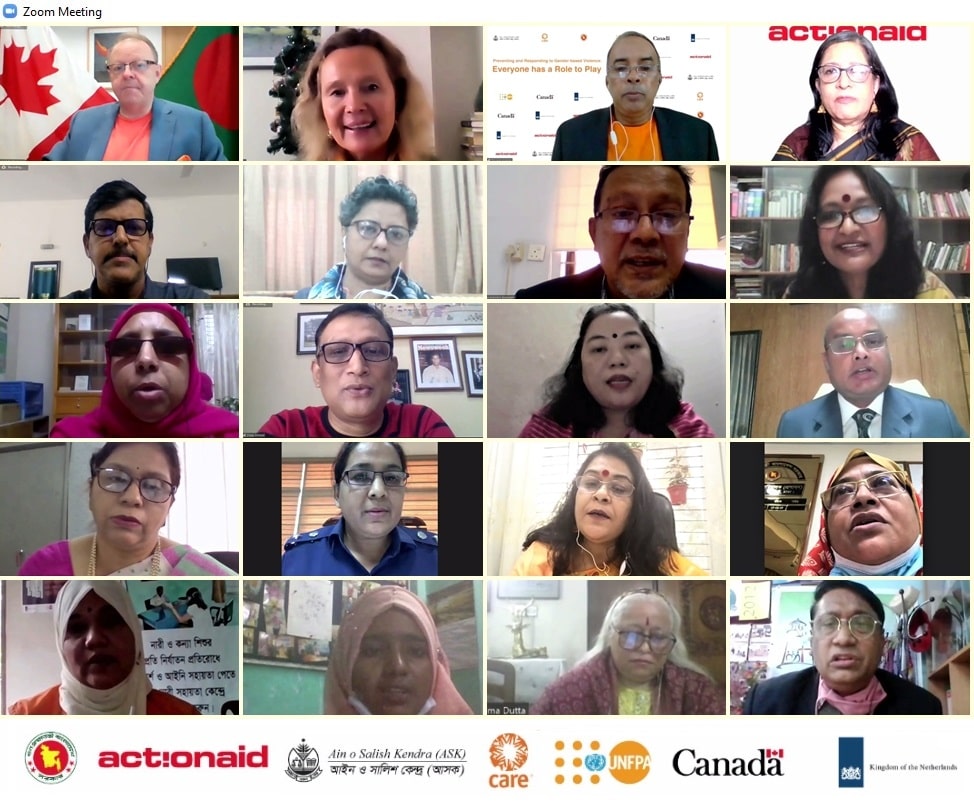
An urgent call for action to prevent and respond to gender-based violence was urged by the civil society organizations, multi-sectoral departments, women’s rights organization, donor agencies, media, and the people in the national level live virtual event titled ‘Preventing and Responding to Gender-based Violence: Everyone has a Role to Play’ that held on 8 December 2020 during the observance of the 16 days of activism against gender-based violence. The event was jointly organized by the United Nations Population Fund (UNFPA) and its partners: Department of Women Affairs, ActionAid Bangladesh, Ain o Salish Kendra, and CARE Bangladesh with support from the Canadian Embassy and Embassy of the Kingdom of the Netherlands to accelerate concrete policy response and promote zero tolerance to gender-based violence across all spheres of society.
This year the UNiTE campaign emphasized taking action from individuals to the private sector to support survivors and advocate for ensuring justice and essential services. Following the international theme – “Orange the world: Fund, Respond, Prevent, Collect!” and the national theme – “Kgjv i‡Oi we‡k¦ bvix, evavi c_ †`‡eB cvwo”, the national-level virtual event was organized to increase awareness, create an opportunity to exchange dialogue and galvanize advocacy efforts to end gender-based violence.
More than hundreds (a total of 150) of civil society organizations, multi-sectoral service providers, policymakers, donors, GBV experts, women’s rights organizations, international organizations, activists, youth representatives, frontline workers, and members of the international community came under one umbrella and committed for a coordinated, gender-sensitive, non-discriminative and collective actions to prevent and respond to gender-based violence (GBV). The event was viewed by over a thousand people (a total of 1180 people) live on different social media platforms of the event organizing partners.
The event was inaugurated with the welcome speech of the Executive Director of Ain o Salish Kendra (ASK). Drawing attention to the violence during the disaster, Golam Monowar Kamal, Executive Director, Ain o Salish Kendra (ASK) said, “During any disaster, women and girls are the worst victims of violence and the COVID-19 lockdown has put them in a more vulnerable position. According to the ASK’s media monitoring report, more than 2500 women and girls have been the victim of this shadow pandemic from January to October of this year.”
“Preventing gender-based violence is everyone’s agenda. Everyone has to play their role to ensure an equal world for all. The government must take effective actions to implement the existing laws and directives of the high court to prevent sexual harassment and all forms of violence against women and girls; as per the child marriage restrain act, each union, Upazila and district should have child marriage prevention committees and the reservation of Articles 2 and 16.1(c), relating to the rights of women during marriage and divorce in United Nations Convention on the Elimination of All Forms of Discrimination Against Women (CEDAW) should be withdrawn” recommended by the Executive Director of ASK in his concluding speech.
The event started with an animation show titled ‘Khola Chithi’ that depicted a story of a girl with an equal opportunity which many girls do not have. This contrast storyline expressed the ideal situation and urged that no girl and woman should be discriminated on the ground of gender.
After that in the ‘Stories from the ground’ section, two first responders have shared their experiences and challenges while working with the survivors and recommendations towards the multi-sectoral departments to provide better services to prevent and respond to GBV. Mst. Sheauly Akter, Case Worker of ASTHA project from Gana Unnayan Kendra, Bogura district, and Sabina Yeasmin, Midwife, Women Friendly Space, from BACE, Jamalpur district joined this discussion.
Following that a policy keynote paper on the ‘Access to GBV services: Reality, challenges and recommendations’ was presented by Ainoon Naher, Ph.D., Professor, Dept. of Anthropology, Jahangirnagar University where different service gaps and recommendations towards a more effective system of multi-sectoral services for GBV survivors were discussed.
In the first panel discussion with the intersectional community titled ‘Leave no-one behind’ the honorable panelists Falguni Tripura, Programme Coordinator, Kapaeeng Foundation; Shale Ahmed, Executive Director, Bandhu Social Welfare Society; and Shirin Akhter, Chairman, Women with Disability Development Foundation raised the concern on the discriminative attitude towards the intersectional community that isolates and make them an ‘invisible’ population in the society. They urge to ensure multi-sectoral public services and equal opportunities for all the survivors irrespective of any dimensions identities, e.g. gender, class, ethnicity, religion, disability, sexuality, age, marital status, and location.
In the second panel discussion with the multi-sectoral departments titled ‘Access to multi-sectoral public services’ the honorable panelists Prof. Dr. Abul Bashar Mohammad Khurshid Alam, DG, DGHS, Ministry of Health and Family Welfare; Prof. Dr. Nasima Sultana, Add’l DG (Administration), DGHS, Ministry of Health and Family Welfare; Dr. Sheikh Muslima Moon, Add’l Director (Deputy Secretary), Department of Women Affairs; Md. Saiful Islam, District Judge & Director of NLASO, Ministry of Law, Justice & Parliamentary Affairs; Dr. Ashrafi Ahmed, Joint Secretary, Department of Social Service; and Mahfuza Akhter, AIG (Training 2), Bangladesh Police, Police Headquarters have shared about the efforts of the government to tackle the increasing violence and committed to ensuring a coordinated, non-discriminative and unified actions to prevent gender-based violence.
The event was also insightful with the speeches of the guest of honors and special guests. In the event HE Benoit Prefontaine, Ambassador, Canadian Embassy said, “The solution of preventing gender-based violence is respecting other human beings. The current increased statistic of violence should not be viewed as just background data, but as an urgent call to enhance the action against sexual violence.”
“Our collective fight against violence against women and girls requires us to be champions of change. It requires youth, both female and male, together with men and women to also be champions in the quest to end the worldwide epidemic that is gender-based violence. Canada’s Feminist Assistance Policy recognizes that supporting gender equality and the empowerment of women and girls is the best way to build a more peaceful, more inclusive, and more prosperous world” he concluded.
Dr. Asa Torkelsson, Representative, UNFPA said, “We say ‘Enough!’ to domestic violence; ‘Enough!’ to rape; ‘Enough!’ to harmful practices such as child marriage; and ‘Enough!’ to sexual violence. Everyone has a role to play in making sure we end all forms of gender-based violence, and today’s event is a testament to how each of us can play our part, collectively, and individually.”
Farah Kabir, Country Director, ActionAid Bangladesh has expressed her strong position on zero tolerance to child marriage and emphasized educating girls and engaging men and boys to sensitize on the harmful effects of power over to reduce all sorts of violence and Ram Das, Deputy Country Director-Humanitarian, CARE Bangladesh has urged to take the pledge to prevent all forms of violence at home, workplace and in the society at large and to concentrate on removing the existing disparity across the gender.
The core recommendations shared during the event are as follows:
- raise greater public awareness against GBV that includes strengthening public awareness campaigns related to all forms of GBV, and how to access multi-sectoral services
- pay special attention to raise awareness among men and young boys to prevent the normalization of GBV
- promote access to education for women and girls beyond secondary school, empowering women and girls socially and economically
- create public awareness in a way that all law enforcement officials and other duty bearers are held accountable for their actions or inactions in relation to GBV, demand for better support and services for GBV survivors
- improve the existing system, including the greater capacity of all service providing agencies and organizations, more effective coordination among them, and improved data management
- Provide more shelter homes – at least one in every district – including shelter homes for boys, support NGOs financially to run such homes
- ensure that all survivors have access to necessary financial support, housing, legal assistance, support services, counseling, and health and mental health services
- ensure that courts, public hospitals, police stations, prisons, Victim Support Centers, and One-Stop Crisis Centers all cater to specially disadvantaged groups as per existing laws and policies
- develop and implement strategies to recruit and retain more female police officers, prosecutors, and judges.
- ensure proper enforcement of all relevant laws
- contribute more resources to expanding and increasing the capacity of Victim Support Centers
- provide sufficient training to police, prosecutors, and judges on handling gender-based violence cases, and on their support for gender equality and women’s rights, along with attention to disadvantaged groups such as the disabled and ethnic minorities.
- create an online centralized filing system for all gender-based violence cases
- bring about changes in relevant laws, e.g. amend the Dowry Prevention Act, 2018 by removing sections that currently criminalizes false allegations about dowry demands and both giving and receiving of dowry; revise the Child Marriage Restraint Act to set the minimum age of marriage at 18 for women and men with no exceptions, reform the rape law by providing a more inclusive and broader definition of rape and removing the character assassination of the rape survivor
- enact a law to protect victims and witnesses
- following the CEDAW Committee’s General Recommendation 33, establish an independent oversight mechanism tasked with addressing gender-based discrimination by justice system professionals
- finalize, publish, and implement the National Action Plan to Eliminate Child Marriage for 2015-2021
- organizing training in every multi-sectoral departments on GBV issues,
- Need speedy trial within 6 months to one year for the GBV cases to reduce violence against women.
- ensure social safety and security of the survivors through law-enforcement agencies
- assign female psychosocial counselors at every union.
- ensure availability of the medical supplies such as iron tablets and folic acid at the Upazila level Women Friendly Space for the pregnant women of the remotest areas
- increase the number of Women Friendly Space to ensure services for larger community women
- more awareness programme on access to available multi-sectoral services and government’s helplines should be conducted among the ethnic minority women and girls who lives in both hills and plains
- adequate facilities and safety-security should be ensured for the survivors at the victim support center and OCC, operating in the hill tracts areas
- the process of seeking legal support should be hassle-free and financially affordable for the survivors, at the same time safety-security of the survivors should be ensured during the process
- multi-sectoral service points should not be the only city-centered, to ensure no-one is leaving behind these service points should be located at the marginal areas
- 50 indigenous communities have different languages and culture in Bangladesh. To remove the linguistic barriers there should be interpreters at the service points
- regular conversation on gender issues is required
- a broader definition of rape including all the gender perspectives,
- stating a clear and specific definition of the term ‘Hijra’ in government’s policy documents
- to ensure inclusive development the high court’s directives on sexual harassment should be filtered through the gender lens
- mental health facilities for the intersectional community need to be prioritized
- to achieve SDG 5 and SDG 16 goal, the CSOs and government organizations need to be held accountable
- the Nari-o-Shishu Nirjatan Daman Ain (Women and Children Repression Prevention Act) 2000 (later amended in 2003), Rights and Protection of Persons with Disabilities Act 2013, the evidence act and Muslim family law should address the barriers, needs and requirements of the women with disability
- service points including the court and police stations need to be accessible for the women with disability
- judges do not understand the language of speech-impaired women and they have a misconception that the visually impaired women cannot identify the sexual harasser, such issues should be addressed and need proper orientation and capacity building on how to handle violence cases of women with disabilities
- need advocacy to prevent sex determination of fetus and raise awareness on preventing the mentality of son preference
- initiate to conduct rigorous research at the national level on the increased GBV issues during the Covid 19 pandemic situation
- moral education should be included in all the academic curriculum of School, college, and madrassa level to build a respectful mindset towards women and girls
- comprehensive sexuality education should be ensured at the educational institutions
- need to develop coordination between all the government and CSOs helplines to ensure better, united and coordinated support for the survivors
- intimate partner violence is always under-reported, more initiatives should be taken to raise awareness on this issue and also to increase the rate of reporting violence.
- research should be done on how many new-born children are abandoned at the dustbins.
- forceful abortion and selective abortion of female fetuses should be prevented through legislation.
- there is a lack of knowledge and awareness on preserving evidence of violence among the survivors and in some cases, the Investigation Officers (IOs) are also not aware of the process. More training and awareness activities are required in this regard.
The event has created an opportunity to exchange dialogue between the CSOs and multi-sectoral service providers where the speakers have emphasized ensuring multi-sectoral public services for gender-based violence survivors in a coordinated and non-discriminative means so that it encourages the survivors to report violence and get justice hence reduce the violence. The two-hour-long events ended with the commitment of civil society organizations and multi-sectoral departments to take prompt, supportive, and empathic collaboration to find innovative solutions to end gender-based violence.


 Visit Today : 2023
 Visit Yesterday : 1917
 Total Visit : 424591
 Who's Online : 11