
Academic Visit of Mr. Maina Kiai, the UN Special Rapporteur on the Rights to Freedom of Peaceful Assembly and of Association
The UN Special Rapporteur on the Rights to Freedom of Peaceful Assembly and of Association, Maina Kiai, came to Bangladesh on 21- 22 September 2014 for an unofficial academic visit.
Ain o Salish Kendra (ASK) along with Asian Forum for Human Rights and Development (FORUM- ASIA) organised an informal interaction with Mr. Maina Kiai , the UN Special Rapporteur on Freedom of Peaceful Assembly and of Association on 22 September 2014 at Chayanaut Auditorium, Dhanmondi, Dhaka.
[vimeo video_id=”108876983″ width=”400″ height=”300″ title=”Yes” byline=”Yes” portrait=”Yes” autoplay=”No” loop=”No” color=”00adef”]
The Special Rapporteur on freedom of assembly and of association has the mandate to conduct official visits to States, providing an opportunity to examine in detail the enjoyment of the rights to freedom of peaceful assembly and of association, to identify problems and make recommendations on how these could be resolved.
The purpose of the Special Rapporteur’s academic visit was to engage with human rights defenders in Bangladesh on the country’s situation on rights to freedom of peaceful assembly and of association with the view of highlighting key issues of concern in the country. Since the establishment of the mandate in 2010, the Special Rapporteur has presented three annual reports to the UN Human Rights Council (UNHRC), focusing on best practices to promote and protect the rights to freedom of peaceful assembly and association (A/HRC/20/27); funding of associations and holding peaceful assemblies (A/HRC/23/39); and the rights of freedom of peaceful assembly and association of groups most at risk (A/HRC/26/29); and one report to the UN General Assembly, on the topic of the rights to freedom of assembly and of association in the context of elections (A/68/299).
The Special Rapporteur’s academic visit to Bangladesh is organised against the backdrop of recent allegations on violations of these rights in the country. Allegations of crackdown on protests in the run-up to its most recent general elections, recent reports of attacks on human rights defenders, and the process of bringing new legislation restricting the right to freedom of association, are some of the key concerns in Bangladesh that falls directly within the mandate of Special Rapporteur. Moreover, some of these key areas have been recently addressed by the Special Rapporteur through his previous reports and recommendations, as outlined above, thus making the academic visit highly relevant to the context of Bangladesh.
John Liu, Program Manager of Asian Forum for Human Rights and Development ( FORUM- ASIA ) and Sultana Kamal, Executive Director of Ain o Salish Kendra (ASK) were present as the speakers of interaction along with representatives of civil society, print and electronic media, human rights activists, lawyers, students of universities etc.
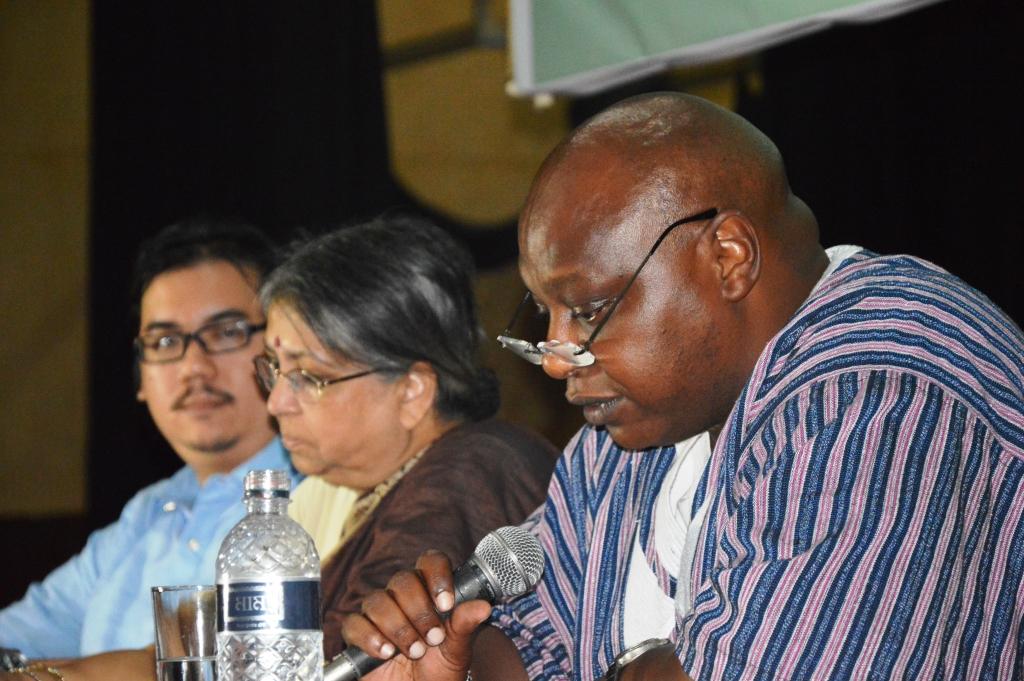
Maina Kiai with Sultana Kamal and John Liu
Highlights of the discussion:
- Peaceful assembly means if the intention of organization or of the protestor is peaceful. Best practices should be peaceful assembly across the world.In case of violent protest, people who will chose violence cannot seek support from the HR mechanism or international community.
- Where people are protesting in a assembly, sometimes some people get violent. In that case, the incident doesn’t change it as not-peaceful assembly. In that context where few people are violent, the role of the state or the police is to take them out from the assembly through the road so that peaceful protestors can continue that. When ten people are creating violence that doesn’t make it violent assembly.
- The fact is people are also threatened by the massive show of force by the police or the state or the militant or the RAB (in Bangladesh). The role of the state is not to stop or dispatch the assembly, but to facilitate the assembly and ensure the safety of the protestors and also of those who are not protesting in the assembly.
- If Intention of the protestors is to do peaceful assembly, state’s role is not to stop protestors.Broadly, police has to be identifiable and chain of command has to be present. Police is not to protect anything but people.
- Has made official request to visit the Bangladesh in 2014.


 Visit Today : 1492
 Visit Yesterday : 1917
 Total Visit : 424060
 Who's Online : 9