
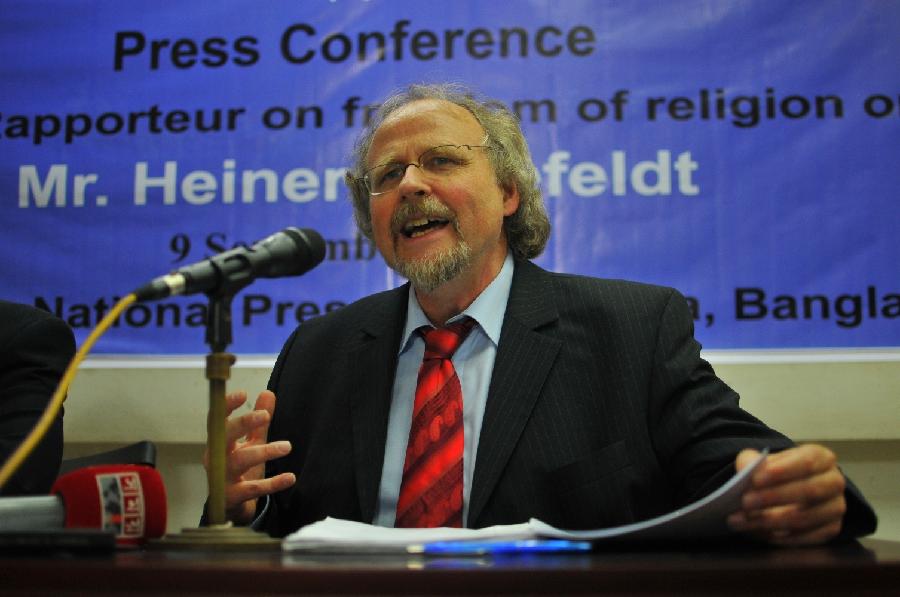
 Heiner Bielefeldt, the UN Special Rapporteur on freedom of religion or belief, speaks during a press conference at the National Press Club, Dhaka, Bangladesh, 9 September 2015
DHAKA/GENEVA (9 September 2015) – The UN Special Rapporteur on freedom of religion or belief, Heiner Bielefeldt, said on 9 September 2015 that “the Constitution of Bangladesh, which enshrines the principle of secularism while at the same time proclaiming Islam as the official State religion gives rise to ambiguities that have a direct impact on human rights in the country, including the protection of religious minorities.”
Bielefeldt, who just ended a nine-day official visit to the country, added that: “Secularism in Bangladesh represents a commitment, entrenched in the Constitution, to create and uphold an open and inclusive space for religious diversity, free from fear and discrimination. Such an ‘inclusive’ understanding of secularism requires the State authorities to take concrete action and make long term investment in education, civil society development, minority outreach programmes and other activities.”
The Special Rapporteur acknowledged the Government efforts to improve freedom of religion and belief in the country and noted specific measures taken in favour of religious minorities who feel under pressure. However the UN human rights expert observed worrying trends towards compromising the principle of secularism, possibly with the intention of appeasing religious militants.
The UN expert also noted that some of the measures established to preserve secularism seem to lead to the opposite result and to a shrinking of the very space that secularism – like democracy – is supposed to provide.
“For instance, a number of official statements on the recent murders of online activists were ambiguous. While condemning the threats and acts of violence, Government representatives also admonished individuals expressing critical views on religion, asking them not to go ‘too far’ in their criticisms,” Mr. Bielefeldt said.
While trying to fight the instrumentalization of religions, the Government itself should also refrain from using religion to achieve political goals, said the independent expert. He called upon the State authorities to bring the existing norms and practices in line with everyone’s right to freedom of religion or belief and freedom of expression as enshrined in the country’s Constitution.
Mr. Bielefeldt visited Bangladesh from 31 August to 9 September 2015. In Dhaka and Chittagong Hill Tracts, he met with various government officials and local authorities. He also held meetings with representatives of religious, belief and diplomatic communities, as well as with academicians, civil society organizations and the UN.
The Special Rapporteur will present a report containing his conclusions and recommendations to the UN Human Rights Council in 2016.
http://www.ohchr.org/EN/NewsEvents/Pages/DisplayNews.aspx?NewsID=16399&LangID=E



 Visit Today : 1629
 Visit Yesterday : 1997
 Total Visit : 400488
 Who's Online : 5