
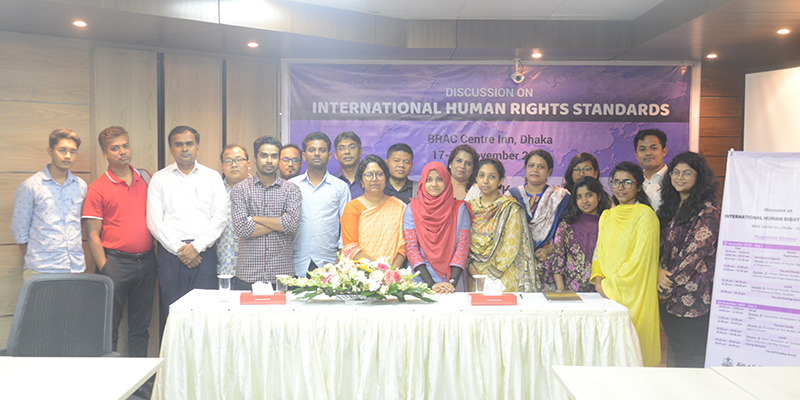
With the aim of orienting human rights and development organisations with the basics of international human rights standards and activating them to conduct relevant advocacy initiatives through the international human rights mechanisms, Ain o Salish Kendra (ASK) organised a two-day long Discussion on International Human Rights Standards, from 17 – 18 November 2019 which was held at BRAC Centre Inn, Dhaka. Representatives, primarily from different human rights and development organisations that continuously work and advocate for human rights in Bangladesh, participated in this discussion. In order to give the participants a comprehensive idea about the international human rights standards, the two-day long discussion was divided into multiple sessions that were taken by experts at relevant fields, so that the participants can take back the due learning from the sessions and use such knowledge to engage themselves with the mechanisms and do follow-up or advocacy with the government to implement their human rights commitments.
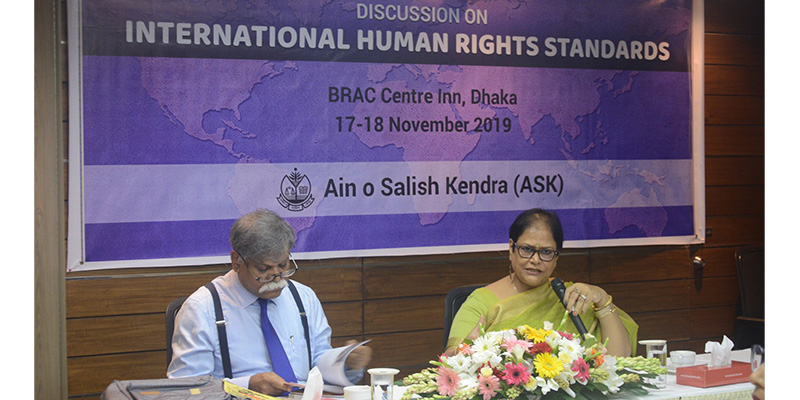
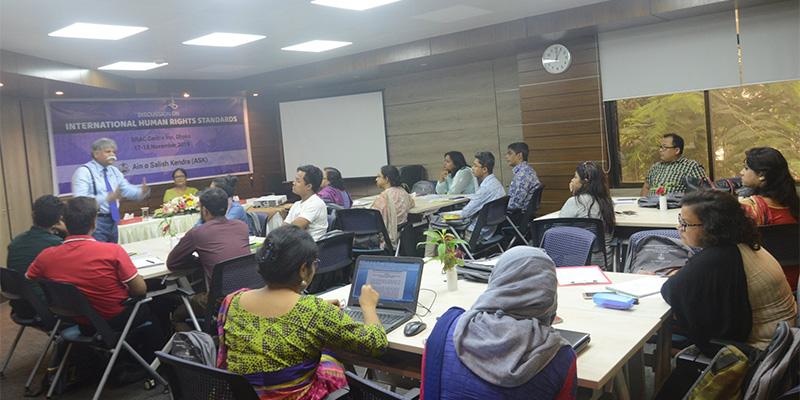
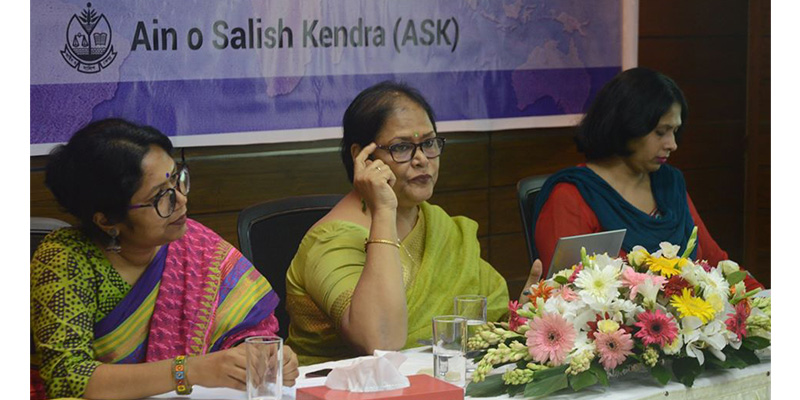
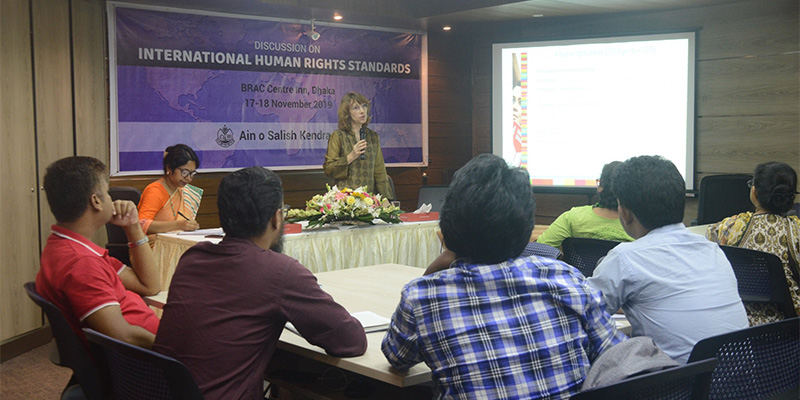
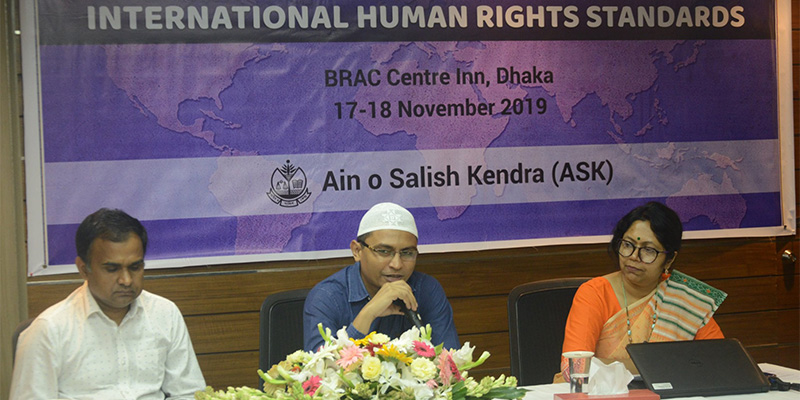
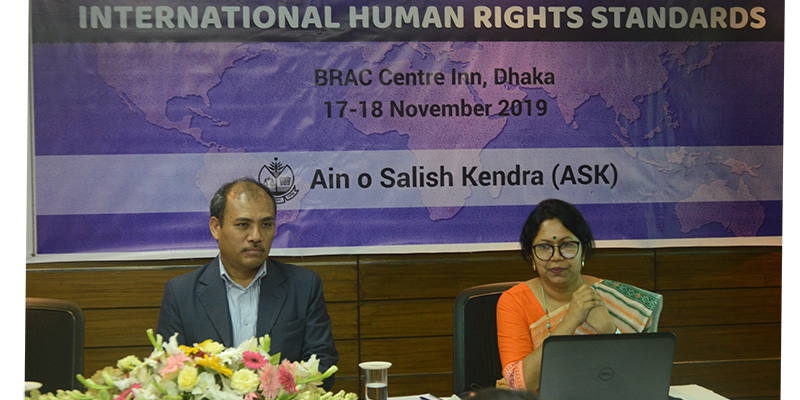
After giving her opening remarks to the discussion, Sheepa Hafiza, Executive Director, ASK, handed over the discussion to Dr Md Mizanur Rahman, Professor, Department of Law, University of Dhaka, who briefed the participants on the multiple aspects and concepts of human rights. He also shared with the participants the current human rights situation of Bangladesh.
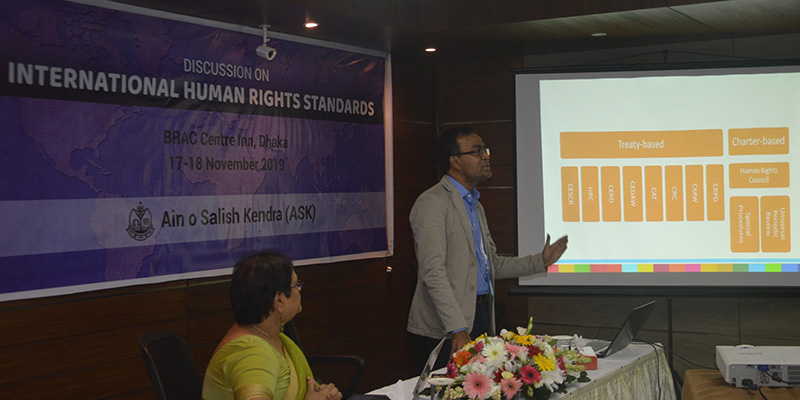
In the next session, Zahid Hossain, Human Rights Officer, United Nations Resident Coordinators’ Office (UNRCO), briefed the participants on the UN Human Rights Mechanism under charter-based and treaty-based bodies. He shared the ways in which the civil societies can engage themselves with the human rights mechanisms more actively at the two-tiers respectively.
To give the participants a brief idea of one of the charter based mechanism, a Panel discussion on Universal Periodic Review (UPR) was arranged where the discussants shared a preview of the UPR process with the participants. Tamanna Hoq Riti, Assistant Coordinator, ASK, went deeper into the UPR process and later focused on Bangladesh’s engagement with this process since 2009. During this panel discussion, Sheepa Hafiza, ED, ASK, shared her experience of civil society organisations on their engagement with the relevant stakeholders as well as the government of Bangladesh on the UPR process. Lubna Yasin, Human Rights Programme, UNDP, presented the national scenario and the experience of other countries in this process and expressed how this one platform allows the civil societies, as well as relevant stakeholders at both national and international level, to directly engage with the government representatives of other countries to place focus on certain human rights issues that require special advocacy.
The next day of the Discussion, Heike Alefson, Senior Human Rights Adviser, UNRCO, took a session on Sustainable Development Goals (SDGs) and Human Rights. During this session, she highlighted on the significance of human rights to the achievement of sustainable development goals and vice versa. She expressed how Agenda 2030 takes a human rights-based approach as they are grounded in international law, focus greatly on equality and non-discrimination, universal and participatory in nature, and strongly advocates for the accountability of the state institutions and the state towards its own people. Through mapping linkages between human rights and SDG, she showed how every single goal focuses on multiple aspects of human rights. Lastly, she gave an overview of the assessment of progress by indicators with special focus on Goal 5 (Gender Equality) and Goal 16 (Peace, Justice and Strong Institutions).
Following this session, Tamanna Hoq Riti, ASK, along with Sanjeeb Drong, General Secretary, Bangladesh Indigenous Peoples’ Forum (BIPF) enlightened the participants about reporting under a treaty-based human rights mechanism by using the very recent review of Bangladesh by the Committee against Torture, as a case in point, which took place on 30 and 31 July 2019. Giving a brief context to the issue, they detailed out their overall experience and the specific highlights of the review with the participants.
After the sharing experiences of the review, the discussion was closed with the panel discussion on the Challenges of Human Rights Defenders, which was moderated by Tamanna Hoq Riti, ASK. During the panel discussion, Abu Ahmed Faijul Kabir, Senior Coordinator, Advocacy and Networking, ASK, shared the existing challenges faced by the human rights defenders from the perspective of those at the grassroots level, the primary one being the reservation of the family members or the people from the locality in sharing the incidents. Besides, most times, the human rights defenders themselves fall victim to harassment and violation when they partake in raising their voices against human rights violations. Gaji Salauddin, Deputy Director, National Human Rights Commission, Bangladesh, briefed the participants about the existing mechanism of the NHRC to protect the HRDs.
The participants expressed their interests as well as acknowledged the newness that was brought about in this Discussion through the detailed discussion on the charter-based UPR Review and treaty-based CAT Review session. As many of the organisations were unaware of the overall process and ways to engage actively with the review process, this discussion gave them a foundation and orientation on where to start.


 Visit Today : 411
 Visit Yesterday : 1445
 Total Visit : 397273
 Who's Online : 11