
Ain o Salish Kendra (ASK) organised a webinar titled “The Hidden Cost of SGBV: How Gender-Based Violence Affects Education, Careers and Well-being”. The webinar brought together students, teachers, civil society members, activists, academics and practitioners to discuss the often unseen and long-term consequences of sexual and gender-based violence (SGBV).
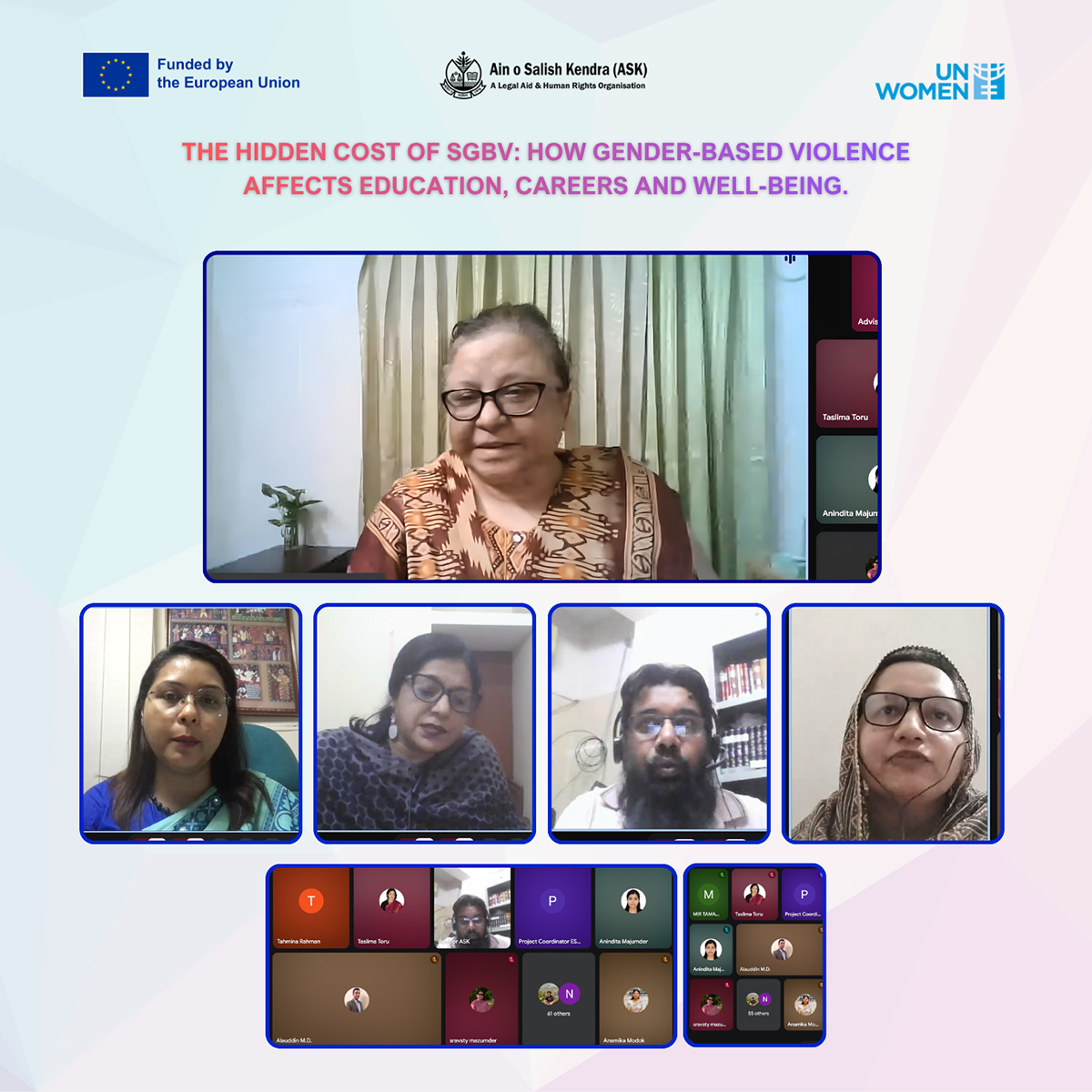
The webinar was hosted by Ms. Tahmina Rahman, Executive Director of Ain o Salish Kendra (ASK). In her opening remarks, she said, “Violence and discrimination must be addressed as mainstream issues, not merely as cross-cutting concerns. Combating such violence requires both public awareness and effective state-level mechanisms.”
Dr. Marufa Akter, Associate Professor, Department of Global Studies and Governance, Independent University, Bangladesh (IUB), presented a thought-piece highlighting the far-reaching impact of SGBV, particularly in educational institutions. She noted that SGBV can disrupt education and career trajectories, affect well-being and family relationships, silence voices, and have consequences that extend to the next generation. She further added, “Not all forms of sexual and gender-based violence are visible. Under-reporting must not be mistaken for the absence of violence; we must recognize and address the invisible suffering of survivors.”
The panel discussion featured Mst. Taslima Khatun, Professor, Department of Sociology, Khulna University, and Mir Tamanna Siddika, Associate Professor, Department of Gender and Development Studies, Begum Rokeya University, Rangpur (BRUR).
Speaking on emerging forms of violence, Mst. Taslima Khatun said, “Technology-facilitated violence is an emerging concern that requires state-level mechanisms to ensure effective reporting, protection, and legal support for survivors.”
Addressing the barriers survivors face in reporting and seeking support, Mir Tamanna Siddika observed, “A lack of survivor-centered approaches and the influence of hegemonic masculinity can reinforce victim-blaming and stigma, discouraging survivors from reporting violence or seeking support.”
Mubrook Mohammed, Advisor, ASK, emphasised the importance of survivor-centred approach, trusted and effective complaint mechanism that should be clear, predictable, protect against retaliation.
The discussion underscored the need to recognise both visible and invisible forms of SGBV and to strengthen prevention, survivor-centred support, reporting mechanisms, institutional accountability and state-level responses.
The active participation of students, teachers, civil society members and activists enriched the discussion, creating space for diverse perspectives on preventing SGBV and building safer and more supportive educational and social environments.
Through this dialogue, ASK continues to promote informed discussion and collective action towards preventing gender-based violence and advancing a safer and more equitable society.
The webinar was arranged under ESGBV Project, supported by UN Women and funded by EU.


 Visit Today : 701
 Visit Yesterday : 0
 Total Visit : 379561
 Who's Online : 18