
ASK is involved with relevant international networks and mechanisms entrusted to monitor the performance and compliance of the National Human Rights Commission (NHRC). As a member of Asian NGOs Network on National Institutions (ANNI), ASK strengthened its international advocacy for the establishment of independent and effective NHRC since 2006. Ain o Salish Kendra (ASK) hosted the 8th Regional Consultation of Asian NGO Network on National Human Rights Institutions (ANNI) in association with Asian Forum for Human Rights and Development (FORUM-ASIA) in Dhaka, Bangladesh between 26 and 27 April 2015.

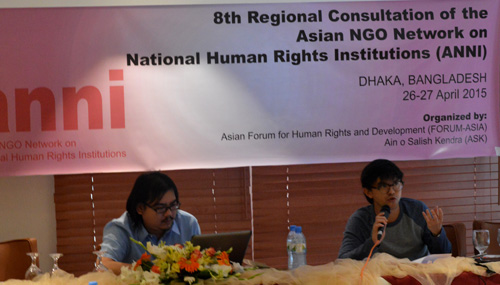
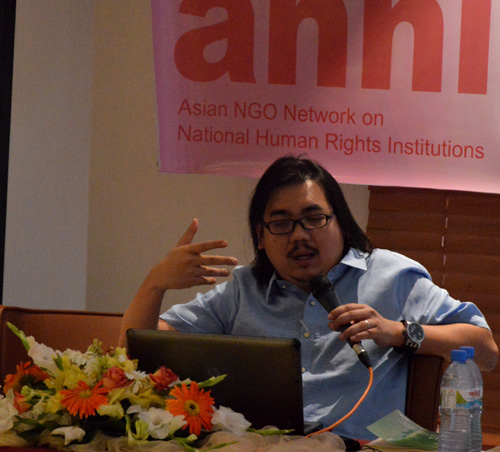
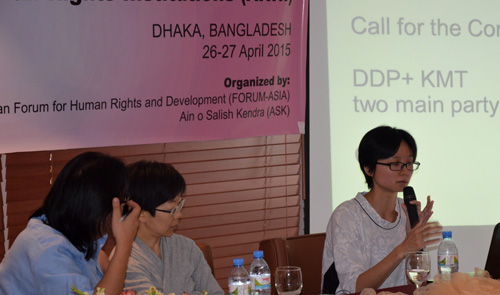
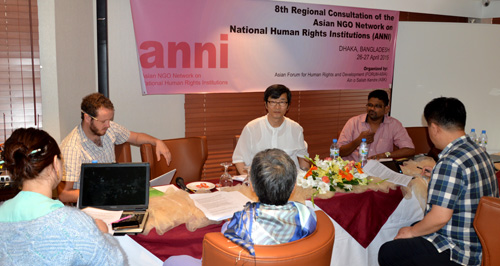
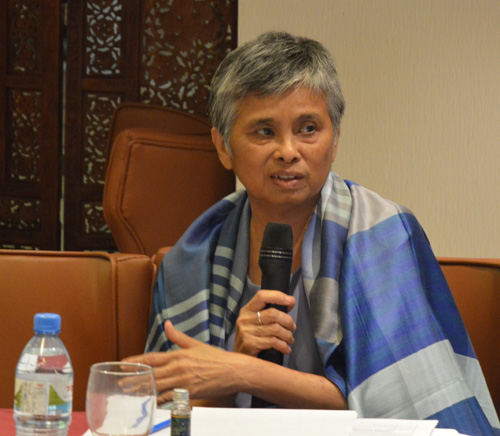
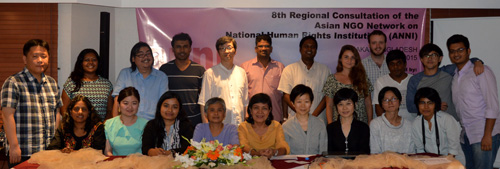
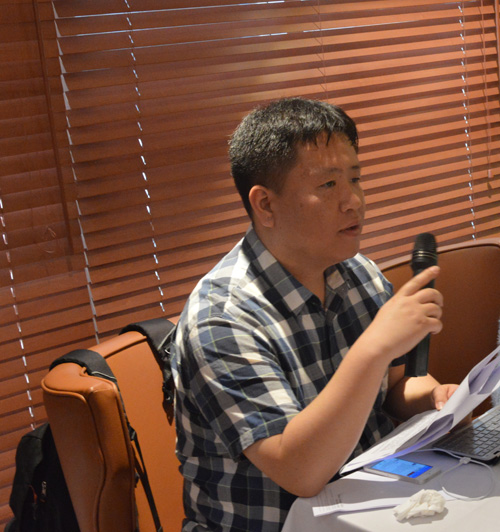
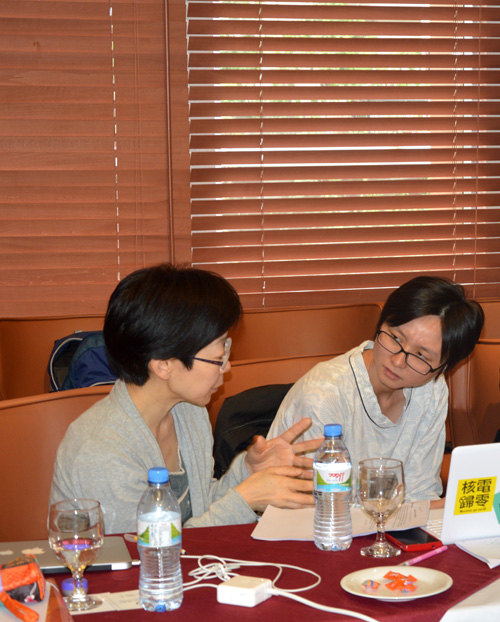
The Members of Asian NGO Network on National Human Rights Institutions (ANNI) from Nepal, Sri Lanka, Malaysia, Thailand, Mongolia, Maldives, Korea, Japan, Cambodia, India and Taiwan highlighted the human rights situations in their respective countries and also the status of implementation of recommendations in past ANNI reports at the regional consultation.
As member of ANNI, ASK raised the following:
- Problematic structure (practice of secondment still exists, no legislative initiatives or amendments despite 6 years of existence);
- NGO law has not been passed but some provisions have been used to certain extents but NHRC keeps quiet;
- Broadcasting Policy for Media in Bangladesh also could be used for suppressing on freedom of expression but NHRC has no opinion on the draft as well;
- Verbal response to the human rights situations of Bangladesh from NHRC chair but no such concrete action was taken as Commission;
- The NHRC has a complaint handling function but there is no effective procedure in place of complaint receiving as well as clear guidelines that informs the interventions.
Recalling
1. The publication and wide dissemination of the 2014 ANNI Report on the Establishment, Effectiveness and Performance of National Human Rights Institutions in Asia, in September 2014; and welcomes the translation of country reports in the following languages: Bangla, Burmese, Sinhala and Tamil;
2. The ANNI Regional Conference on “The Role of NHRIs in the National Protection System” preceding the latter’s 19th Annual Meeting of the Asia Pacific Forum of NHRIs in New Delhi, India between 30 September and 01 October 2013, with the participation of Chairpersons of Bangladesh Human Rights Commission Dr. Mizanur Rahman and the Afghanistan Independent Human Rights Commission Dr. Sima Samar; former members of the Nepali Human Rights Commission Mr. Sushil Pyakurel and National Human Rights Commission of Korea Prof. Kwak Nohyun, former Chairperson of the National Commission of Women Dr. V. Mohini Giri and Commissioner from the NHRC India Mr. Satyabrata Pal, as well as the Director of the APF Secretariat Mr. Kieran Fitzpatrick;
3. The launch of the 2014 ANNI report at the APF19 annual meeting in the presence of Chairpersons and representatives of NHRIs from the Asia–‐ Pacific region;
4. The participation of ANNI members in APF-19, including the second roundtable dialogue between an ANNI delegation and Forum Councilors, including written and oral submissions to the APF Strategic Plan 2015-2020;
5. The Independent Peoples’ Tribunal (IPT) in New Delhi, India from 14-16 December 2013 on the occasion of 20 years of the Paris Principles and the Protection of Human Rights Act to assess the effective work and functioning of the NHRC India;
6. The UN Human Rights Council Resolution (A/HRC/RES/27/18) of 7 October 2014 that stresses the importance of financial and administrative independence and the stability of national human rights institutions for the promotion and protection of human rights and recognizing that national human rights institutions and their respective members and staff should not face any form of reprisal or intimidation, including political pressure, physical intimidation, harassment or unjustifiable budgetary limitations, as a result of activities undertaken in accordance with their respective mandates.
Resolving
7. To produce the 2015 ANNI Report on the Establishment, Performance and Effectiveness of National Human Rights Institutions in Asia based upon the guidelines discussed and approved at the 8th Regional Consultation and with the support of ANNI secretariat; and to ensure wide dissemination of the report, including in soft copy format, through a media and communications strategy to a broad spectrum of stakeholders and constituencies;
8. To follow up with the NHRIs in their respective countries on the status of implementation of recommendations in past ANNI reports;
9. To encourage ANNI members to continue to translate the country chapters in the ANNI Report into local languages;
10. To publish and widely disseminate an ANNI E-bulletin twice a year and encourage contributions from ANNI members;
11. To use the 2012 Belgrade Principles on the Relationship between National Human Rights Institutions and Parliaments, in advocacy with parliamentarians towards ensuring greater accountability of National Institutions where they exist, and for the establishment of NIs where they are not yet established; and encourage the participation of and engagement with parliamentarians in future ANNI meetings through groupings/networks, such as the Inter-Parliamentary Union (IPU) and Asean Parliamentarians for Human Rights (APHR), and individual MPs where such groupings do not exist;
12. To encourage ANNI secretariat and its members/partners to participate in the Universal Periodic Review and its follow-up processes advocating the consistent recommendation of the UN Human Rights Council for strengthening of NIs where they exist, including from the ICC–‐SCA review recommendations and for the establishment of NIs in countries where they presently do not exist;
13. To continue to advocate along with its member in Taiwan and other Taiwanese civil society organisations in their campaign for the establishment of a National Human Rights Institution in Taiwan in full compliance with the Paris Principles before the end of 2015;
14. To continue participating in the ICC-SCA Accreditation process of national human rights institutions through the submission of information from civil society organisations; noting that the MNHRC (Burma/Myanmar) will be applying for accreditation and SUHAKAM (Malaysia) will be reaccredited in November 2015 and that the deadline for CSOs is 16 July 2015;
15. To further engage and follow-up with the APF’s Strategic Plan for 2015-2020;
16. To organize a conference of ANNI members, partners, human rights defenders in parallel with the biennial conference of the Asia-Pacific Forum of National Human Rights Institutions (APF) in Ulaanbataar, Mongolia between 24-28 August 2015, specifically to organize a symposium on the relationship between NHRIs and Parliaments, with the participation of regional/international groupings of MPs such as the APHR and IPU, or individual MPs where such groupings do not exist, including those who sit on Parliamentary select or standing committees, as well as relevant stakeholders such as the UN Special Procedures mandate holders;
17. To participate in the 20th Annual Meeting and third biennial conference of, the APF in Ulaanbaatar, Mongolia between 26-28 August 2015, including in a dialogue with the Forum Councilors;
18. To conduct the 9th Consultation of the ANNI in Southeast Asia by March of 2016 in association with the respective ANNI country members; and ensure that the consultation includes representation of local human rights defenders engaging with their National Institution.
19. To formulate an advocacy strategy/campaign with national civil society organizations in Thailand against the merger of the NHRCT with the Ombudsman’s Office;
Finally, the decision to publish the finalized version of ANNI Regional Report 2015 in July 2015 with updates and amendments from writers and agreeing that the period of coverage for the report shall be from January 2014 to December 2014, is made. But some additions of critical developments occurring during the first two quarters of 2015 can be added in the ANNI Report.



 Visit Today : 1851
 Visit Yesterday : 1779
 Total Visit : 415967
 Who's Online : 7